Rosetta Maru
Theodosia and the Serpents of ChaosThe Rosetta Maru is the ocean liner that carries Theodosia’s parents toward Cairo and becomes the means by which she follows them in secret. Its scale, noisy machinery, exposed lifeboat refuge, and eventual approach to Alexandria shape the voyage as both a practical escape from London and a threshold into Egypt. The ship is not merely a route on a map: its decks and lifeboats determine how Theodosia hides, endures the passage, and is ultimately discovered.
The Ship and the Departure
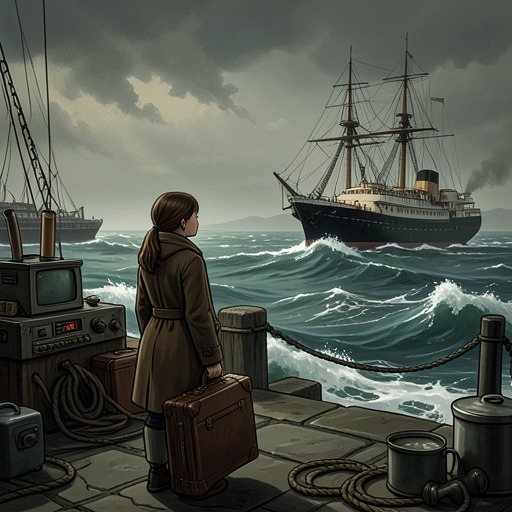
The Rosetta Maru is described as enormous, nearly as big as the Kaiser Wilhelm der Grosse. That scale first registers from the dock, where Theodosia looks up at the liner and sees its lifeboats high on the top deck. She fixes on one of them as her destination, turning a detail of the ship’s safety equipment into the private shelter she will need for the voyage.
The journey begins with a change in her parents’ plans. At breakfast, Henrietta and Alistair announce that they will leave for Cairo aboard the Rosetta Maru the day after next. Alistair is furious that the British Museum might take another Egyptian find from under his nose, and treats the prospect as a personal affront he intends to address himself. He petitions the board of the Museum of Legends and Antiquities for special permission to accompany Henrietta; the board grants it, sharing his unwillingness to let the British Museum get the better of them. The Rosetta Maru thus becomes the vessel of an expedition prompted by professional rivalry as well as family decision. Theodosia tries to persuade her parents to take her, but the ship’s departure proceeds without her openly included.
A Secret Passage Aboard
The docks offer Theodosia an opening. In the surrounding bedlam, she reasons, people struggle to keep track even of themselves, let alone of another passenger. Several families are travelling, and she attaches herself to the largest and noisiest, following behind as they trail their parents. The number of children is difficult to make out: she estimates seven, perhaps six. The uncertain count conveys how effectively the crowd blurs individual attention. She uses that confusion to get aboard, then makes for the lifeboats she had spotted above.
The boat’s size does not make its hidden spaces comfortable. Sleeping in a lifeboat proves beastly, and Theodosia judges it less comfortable than a sarcophagus, despite expecting wood to be softer than stone. One blanket barely keeps her warm. She had planned to use her extra coat as a pillow, but must wear it through the night to avoid freezing; wearing two coats makes movement difficult, and the Egyptian amulet she wears chafes against her. The familiar object of the amulet, brought into the confined shelter, adds another physical irritation to the concealment.
The ship’s machinery makes the lifeboat an uneasy hiding place even when no one is looking for her. The ocean-liner motors are very loud, and their vibration is perceptible where she is sleeping. Cold, hunger, and boredom accompany the noise, leaving her with too much time to think. She tries to make the cramped space feel like a little cave, recalling the sort she and Henry used to build when they were younger. The memory makes her feel unexpectedly lonely, and she pushes it aside. The ship carries her forward, but its narrow refuge also leaves her alone with thoughts she would rather avoid.
Discovery and Arrival in View
The concealment does not last entirely undisturbed. One night, Mr. Wappingthorne visits and brings his fiancée, Miss Pennington, because he wants to prove to her that Theodosia is real. Miss Pennington recognizes what Theodosia’s presence means: she is a stowaway. Mr. Wappingthorne calms her and swears her to secrecy, but Theodosia remains tense until they have left for the evening. Only after she believes the immediate danger has passed does she settle back into her small nest; just as she begins to get warm again, she hears a footstep on the deck. The episode turns the liner’s passage into a continuing risk of exposure, even after the crowded docks have helped her board unnoticed.
A few mornings later, the Rosetta Maru approaches Alexandria. From the deck, Theodosia sees the city rise in the distance, with towers, turrets, and flags outlined against a brilliant blue sky. After the cold and confinement of the lifeboat, the sun’s warmth on her face and shoulders makes the open deck feel like a sharp reversal. She looks out over the deep blue water of Alexandria Harbor, and the city’s name brings the ancient world to mind. The approach does not erase the discomfort or secrecy of the passage; it gives them direction. The Rosetta Maru has carried her from the London docks toward the Egyptian setting of the adventure, making the hidden voyage the physical link between her parents’ departure and her own arrival within reach of Alexandria.